She Fell — And This Time, Someone Caught Her
Echo stepped onto grass for the first time in months, and the world tilted beneath her.
Her hooves, overgrown and tender, sank into the soft earth like they’d forgotten what kindness felt like.
A second later, her legs gave out.
Starvation, darkness, and exhaustion all crashed down at once.
The mare’s body folded, ribs jutting, muscles trembling as if every breath might be her last.
She hit her knees and began to fall, eyes wide with panic, bracing for the pain she’d learned always followed.
But this time, someone ran toward her.
The sound of footsteps wasn’t followed by shouting, or a rope snapped hard against her side.
It came with the rustle of fabric and a voice she hadn’t learned to fear yet.
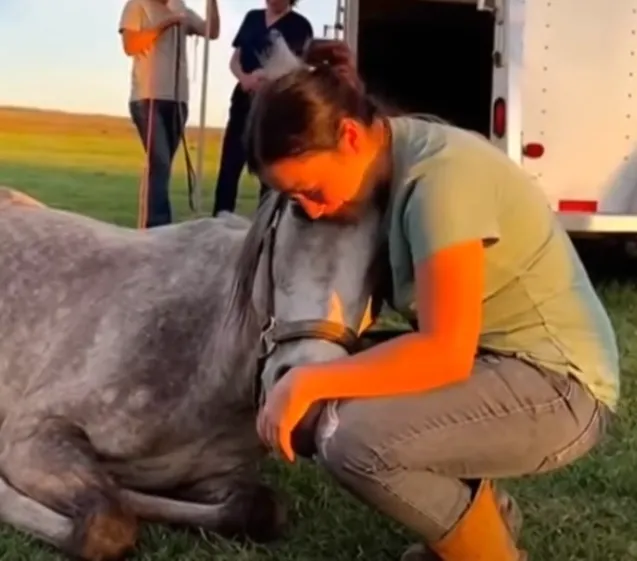
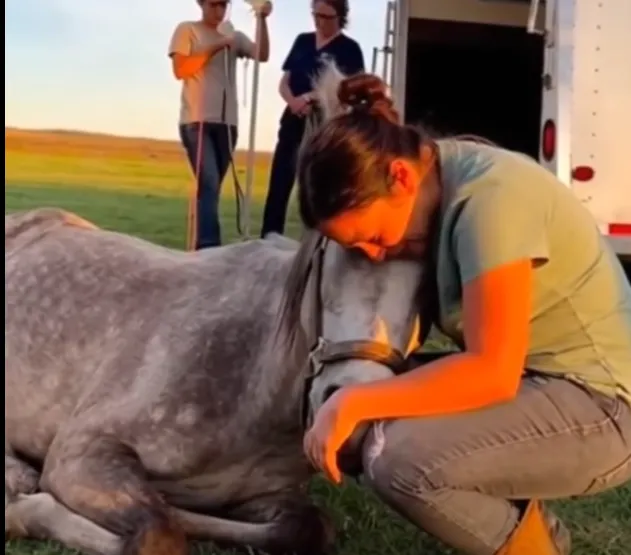
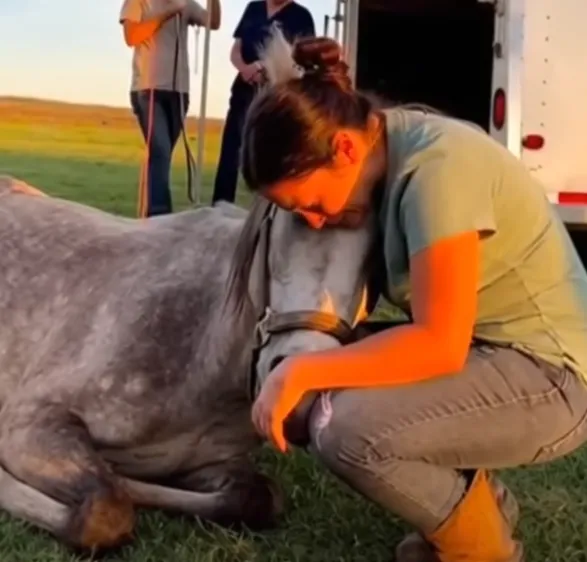
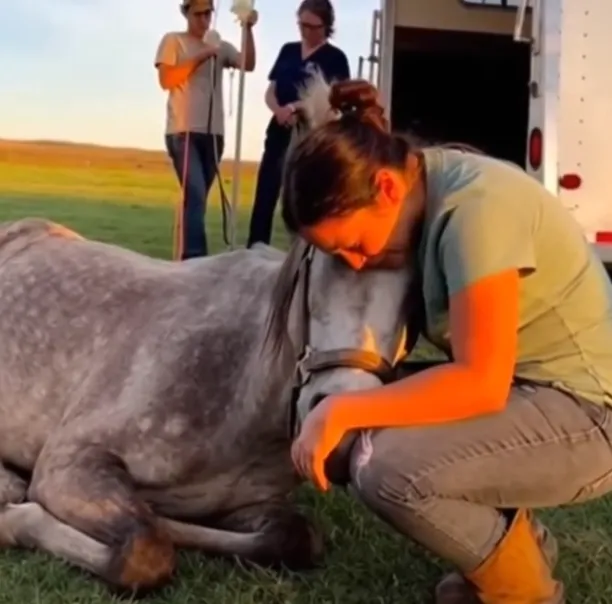
Dr. Lena dropped to her knees in the dirt without hesitation.
She slid under Echo’s heavy head just before it hit the ground, cradling the mare’s jaw against her chest.
Her arms wrapped around Echo’s neck, holding fast like she was catching a falling world.
She didn’t shout.
She didn’t smack Echo’s muzzle or yank on a halter to force her up.
She just stayed there, still and solid, her heartbeat thudding against Echo’s cheek.
“I’ve got you,” she whispered, over and over, like a promise she’d been waiting years to make.
Her breath fanned warm across Echo’s sunken face, the words steady even as dust and hay clung to her scrubs.
For the first time in a very long time, someone’s touch didn’t come with pain.
Echo’s ragged breathing began to slow.
The frantic, rolling whites of her eyes faded as her gaze fixed on this strange human who didn’t hurt her.
Her tense body softened inch by inch, the fight melting into something that felt terrifyingly like surrender.
Instead of struggling to stand, she leaned into the embrace.
Her weight shifted fully, her heavy head resting completely in Lena’s lap.
It was the first time in Echo’s life that falling didn’t mean being alone.
Around them, the rescue staff moved quickly but carefully.
Hands checked vital signs, voices stayed low, and a portable IV stand rattled across the uneven ground.
The air hummed with urgency, but no one pushed Echo harder than her body could handle.
“Let’s get fluids started,” Lena said softly, not lifting her eyes from the mare’s face.
Her fingers traced Echo’s cheek in slow circles, feeling every ridge of bone under the skin.
“She’s been running on fear and fumes for far too long.”
A tech swabbed a patch on Echo’s neck, murmuring apologies she couldn’t understand but somehow felt.
The needle slid in, and the IV line began to drip life back into a body that had nearly given up.
Echo flinched, then stilled when Lena’s hand tightened gently against her.
“That’s it, girl.
You’re okay.
I’ve got you.”
The sun was dipping slowly behind the barns, painting the sky in soft pinks and oranges that Echo didn’t notice.
All she knew was the feel of cool grass under her belly and the warmth of a human who refused to let her hit the ground alone.
The world had always hurt, and suddenly, for a strange and fragile moment, it didn’t.
Hours earlier, the stall she’d left behind had smelled of ammonia, mold, and old fear.
Dark walls pressed in on all sides, the only light a sliver that slipped under a warped door.
Echo had learned to live in that sliver—a narrow, bitter slice of the world where no one came except to take more from her.
Food had arrived in handfuls, when someone remembered.
Water had been murky, a shallow bucket half-kicked and rarely refilled.
The days blurred together, long stretches of standing and waiting because there was nothing else to do.
The first time Echo had fallen there, nobody came.
Her legs had folded from underneath her, hunger wrapping around her bones like a vice.
She’d lain in the dark, breathing dust and stale hay, until she found the strength to stand because no one was coming to help.
Pain had become a language.
The sharp snap of a whip, the rough jerk of a rope, the sting of a kick meant “move” or “shut up” or “too slow.”
There were no gentle words, no soft hands, no “good girl” spoken just because she existed.
By the time animal control found her, Echo had stopped expecting anything different.
She’d watched strange men walk into the barn, their flashlights cutting through dust and cobwebs like jagged beams.
When one of them approached her stall, she’d flattened her ears, bracing for the blow.
It didn’t come.
Instead, a quiet voice said, “Easy, sweetheart,” with a softness that confused her.
A rope slid around her neck, but the pressure stayed light, more like a question than a command.
The trailer ride had been a blur of motion and noise.
Every bump sent pain ricocheting through her thin body, but it also carried her away from the place where she’d been disappearing.
When the doors finally opened again, the air smelled different—clean, sharp with grass and hay, and faintly of other horses.
She’d stepped onto the ramp and hesitated, her legs shaking under her.
Voices drifted from nearby, excited but controlled, as if everyone knew they needed to move slowly.
Then a woman stepped forward, dark hair pulled back, stethoscope bouncing against her chest as she approached.
“I’m Dr. Lena,” she said softly, as if introductions mattered to horses too.
Up close, Lena’s eyes weren’t just assessing; they were grieving for pain she hadn’t caused but refused to ignore.
“We’re going to take care of you now, Echo.”
Echo didn’t know her name yet.
She didn’t understand that the sound “Echo” was meant for her.
But she recognized something else—an energy that didn’t feel like threat.
They led her slowly to a patch of pasture, the grass green and lush.
It was as if the earth had grown a bed just for her battered feet.
Every step was a negotiation between fear, pain, and the possibility of something better.
And then, on that fragile first step into a world that didn’t hurt as much, her legs had failed her.
Old habits took over; her body tensed for the impact, for the yelling, for the sting that always followed weakness.
Instead, she found arms waiting underneath her, refusing to let her fall alone.
IVs were placed.
Medications dripped into her veins, coaxing hydration and calm into the chaos inside her body.
Strength slowly, painfully, began to return in microscopic increments.
But the moment that changed everything wasn’t medical.
It wasn’t the fluids, the supplements, or the carefully measured feedings that came later.
It was being caught.
Someone else took responsibility for the fall.
Someone else stepped into the space between Echo and the ground and said, with their body, “You don’t have to hit bottom this time.”
The entire shape of Echo’s world shifted with that choice.
Days turned into a routine of care.
Small meals, spaced carefully so her fragile system could catch up.
Short walks, hooves trimmed slowly over time, each snip taking away part of the neglect.
Volunteers stopped by her stall to brush her, but they waited until she was ready.
They let her sniff the brush, the hand, the sleeve.
They gave her the choice to step closer or back away, and that choice was a kind of medicine too.
At first, Echo flinched at every sudden movement.
A door slamming, a bucket dropped, a laugh too loud sent her muscles locking tight, eyes wide and ready to bolt.
Lena made a note every time, adjusting the environment piece by piece to make the world softer.
The other horses watched her from their paddocks, ears pricked.
Some whinnied greetings that she didn’t yet know how to answer.
She carried the smell of confinement and fear with her, but slowly, the scent of sunlight and fresh straw began to cling to her instead.
Lena visited her every day.
Sometimes with a stethoscope and charts, sometimes with just an apple and ten quiet minutes.
Either way, Echo began to recognize the sound of her boots in the aisle.
On the fifth day, Echo did something she’d never done before.
Lena walked past her stall, talking to another staff member, hands full of bandage rolls.
Echo took one step forward, stretched her neck over the door, and reached toward her.
Lena stopped mid-sentence.
She turned slowly, eyes softening as she realized what was happening.
Without saying a word, she stepped backward until Echo’s muzzle touched her shoulder.
“There you are,” Lena murmured, as if Echo had come back from somewhere far away.
Her hand came up, palm open, giving Echo the chance to decide.
Echo breathed in the familiar scent—soap, hay, and a hint of coffee—and let her nose rest there.
This time, she didn’t brace for impact.
She didn’t tense waiting for the sharp sting that always followed contact.
She just let herself exist in the moment, leaning into the human who had held her when she fell.
Weeks went by, and Echo’s body began to change.
The harsh angles of her ribs softened as weight returned, coat slowly losing its dull, patchy look.
Her eyes, once flat and distant, started to shine with something like curiosity.
The first time she trotted, really trotted, across the paddock, staff members stopped what they were doing just to watch.
Her gait was uneven, wobbly, like she was trying on the idea of being strong and wasn’t sure it fit yet.
But there was joy in the awkwardness, a flick of her tail that spoke of something new waking inside her.
Lena leaned on the fence, a smile tugging at the corner of her mouth.
“That’s my girl,” she murmured, more to herself than anyone else.
“Fall as many times as you need. I’ll be here.”
Echo’s trust grew in layers.
She allowed her legs to be lifted and examined without jerking away.
She let volunteers braid her mane, the gentle tugging a rhythm she could relax into.
But the true test came on a windy afternoon when a tarp blew loose from a nearby hay stack.
It snapped and billowed like a predator, the sound sending panic shooting through Echo’s chest.
Every instinct screamed at her to run, to bolt, to crash through whatever stood in her way.
She reared slightly, hooves scraping at the dirt.
Memories of dark stalls and harsh hands flashed behind her eyes.
Then she saw Lena, standing still in the paddock, arms open but not reaching.
“It’s okay, Echo,” Lena said, voice barely louder than the wind.
“I’m right here.
I’ve got you.”
Echo’s hooves came back down.
She trembled from neck to tail, sides heaving as fear battled with the memory of being held.
Slowly, one breath at a time, she stepped toward the person who had caught her when she couldn’t hold herself up.
The tarp kept snapping in the background, but its power had changed.
It was no longer the loudest thing in the world.
The steadiness in Lena’s eyes outweighed the chaos in the air.
Echo stopped just an arm’s length away and lowered her head.
Lena stepped forward the last small distance, resting her forehead against Echo’s.
They stood there, sharing breath, each one grounding the other.
Echo didn’t know words like “rescue,” “rehabilitation,” or “second chance.”
What she knew was falling and being caught.
Pain and then relief.
She knew that once, collapse had meant lying alone in the dark until she could drag herself up again.
Now, it meant hands under her head, soft voices, and a promise that someone else would help her stand.
The world hadn’t become perfect, but it had become survivable.
Months later, when a family came to the rescue looking for a horse, Echo watched them from her paddock.
They moved slowly, listening to the staff, asking questions that sounded like care rather than ownership.
A young girl with freckles leaned on the fence, talking to Echo about absolutely nothing and everything.
Echo stepped toward her, drawn by something gentle and familiar.
The girl laughed softly when Echo’s whiskers brushed her fingers.
“She’s beautiful,” the girl whispered, as if afraid the horse might disappear if she spoke too loud.
Lena watched from a distance, hands in her pockets.
Her heart squeezed, pride and sorrow braided together.
Letting go was its own kind of fall.
Weeks of visits followed, patient and consistent.
The family learned Echo’s story, not as a tragedy but as a testament.
They didn’t flinch at the hard parts, and they didn’t rush the healing.
The day Echo finally walked onto a new trailer, the sky was bright and clear.
She hesitated at the ramp, feeling the old fear curl around her ankles.
Then the girl stepped beside her, resting a hand flat on her neck.
“It’s okay, Echo.
We’ve got you now.
You won’t fall alone.”
Echo took a breath that reached all the way down to the place where darkness had once lived.
Her ears flicked back toward Lena, who stood still as stone but smiled with her whole face.
Then Echo stepped forward, not because she was forced, but because she was ready.
She had been thrown away once.
She had been left to stand and fall, stand and fall again, in a world that didn’t care if she stayed down.
But one moment—one person dropping to their knees and catching her before she hit the ground—had rewritten everything.
It hadn’t been the IVs that changed her.
It hadn’t been the medicine or the carefully measured grain, though they mattered too.
It was the simple, devastating miracle of being caught when she had expected to break.
From that day on, Echo carried that feeling with her.
In every step, every breath, every new hand that reached for her, there was a shadow of that first embrace.
A memory that whispered, through all the noise and fear:
You can fall.
Someone will be there.
You are not alone anymore.


Comments
Post a Comment