She Was Trapped in a Tiny Cage and Losing Hope. Until One Decision Changed Chelsea’s Life

In a dim corner of a crowded shelter yard, a rusted cage sat pressed against a concrete wall. Inside it, barely moving, was a small dog named Chelsea.
Her body looked smaller than it should have been. Her ribs showed through thin skin. Her fur hung in tight, dirty mats that pulled at her every time she shifted. The space around her was so narrow she could not stretch fully.
If you had walked past her that day, you might have missed her.
She did not bark when rescuers approached.
She did not retreat.
She just watched.
There is a certain look dogs get when they have stopped expecting kindness. It is not aggression. It is not fear. It is absence.
This rescue was carried out by Rumah Penuh Cinta Bethkiel Familie and later shared through a video uploaded on the Dog Haven YouTube channel. What viewers saw was not just an animal in need. It was a life quietly shrinking inside metal bars.
But this story did not end there.
It turned on one decision.
A Body That Told the Story Before She Could

When the team opened the cage, they paused.
One rescuer described her appearance as “so pitiful.” It was not exaggeration. Her hips were visible. Her spine was pronounced. Her coat had hardened into thick knots that clung to her skin.
According to the American Kennel Club, “Detangling keeps coats from becoming matted and causing painful pulling on the skin.” Untreated mats do more than look neglected. They tug constantly. They trap debris. They can hide wounds beneath layers of fur.
Chelsea’s coat showed how long care had been absent.
Humane World for Animals states clearly, “Failing to provide an animal’s basic needs—food, water, shelter and veterinary care—is cruelty.” When a dog is confined in a cramped space without proper grooming, food, or comfort, that definition stops being abstract.
Here is why this matters.
Neglect reshapes behavior. Some dogs shut down. Some withdraw from contact. Some stop reacting at all.
Chelsea surprised everyone.
When the cage door opened, she stepped forward and tried to play.
Despite everything, her tail moved.
Hunger That Could Not Be Ignored
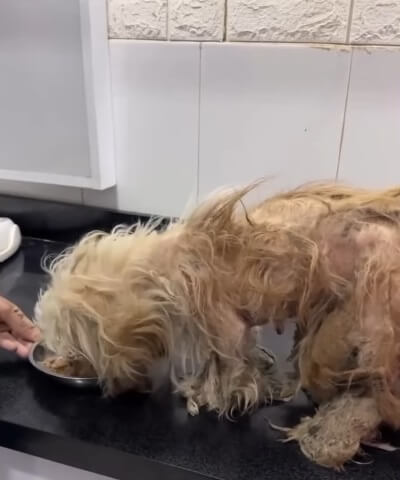
Food was placed in front of her.
She lowered her head and ate urgently, barely pausing to breathe. The rescuers stood still, watching the intensity of it.
It was not just hunger. It was survival instinct.
One member of the rescue team later said, “I don’t know how a human being could hurt a beautiful soul like Chelsea.”
The words were quiet. They lingered.
Chelsea was taken for veterinary care immediately. Her low weight required careful monitoring. Refeeding had to be controlled. Sudden increases in food can stress an already weakened system.
Day one focused on hydration and small portions.
Day two brought gentle grooming. Her matted coat was carefully shaved to relieve pressure on her skin.
By the end of the first week, she had gained a small but measurable amount of weight. Her eyes looked more alert. She began approaching people without hesitation.
Recovery was slow. It was steady.
The Reality Inside Shelters

As Chelsea stabilized, another concern remained.
Space.
The ASPCA notes, “Every year, approximately 6.3 million companion animals enter U.S. animal shelters nationwide.” That number represents constant intake. Limited kennels. Limited time. Limited quiet corners for fragile animals.
Small dogs like Chelsea can struggle in crowded environments. They are easy to overlook. They can be overshadowed by louder or younger animals.
Chelsea needed more than a temporary cage change. She needed a controlled space to continue healing.
Rescue does not end when a cage opens. It continues in the days that follow. In the choice about who steps forward next.
When Rescue Becomes Personal
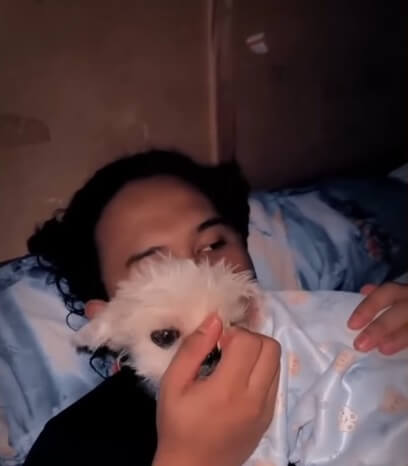
As days passed, Chelsea responded well to treatment. Her appetite stabilized. Her skin began to heal. She started greeting volunteers at the front of her enclosure.
But the shelter environment still carried risk.
One rescuer made a decision that changed everything.
Chelsea would not wait for adoption paperwork. She would not return to uncertainty. She would go home with someone who had already seen her at her lowest.
That shift gave her something she had not known in a long time.
Predictability.
Healing What Cannot Be Seen

Today, Chelsea sleeps inside a home.
She eats on schedule. She walks without fear. She curls beside the couch instead of pressing against metal bars.
Behavioral healing takes time. Dogs who endure confinement often need consistent routines and gentle exposure to rebuild confidence. Small signals matter. A relaxed posture. A playful bounce. A steady gaze.
Chelsea now waits at the door when she hears a leash pick up.
She no longer scans her surroundings for threat.
She looks for affection.
Shelters remain full. Millions of animals enter them each year. When one dog leaves for a home, space opens for another who is still waiting.
Chelsea once waited inside a cage.
Now she waits for her family to come back from the other room.
If Chelsea’s story stayed with you, consider sharing it. The next rescue often begins with someone simply paying attention.


Comments
Post a Comment